Barbara Chaseribouds Bronze Steles and Paper Monuments at the Philadelphia Museum of Art
Barbara Chase-Riboud's Bronze Steles and Paper Monuments at the Philadelphia Museum of Art
(Andrea reviews a show of drawings and monumental sculptures in bronze and other materials by Barbara Chase-Riboud and finds them filled with historical, art historical and cultural references from across cultures and through time.–the Artblog editors)
In the Philadelphia Museum of Fine art'due south (PMA ) stunning installation, each of Barbara Chase-Riboud'due south 5 works from the series she defended to Malcolm X, stands in its ain niche. She calls them steles, a term for upright, stone monuments inscribed with text, and a form that has survived from various ancient civilizations. Chase-Riboud'due south steles are mysterious and imposing. Lit candles on the flooring before them would not expect out of place. Each is alpine (from half-dozen ½ to 10 feet), frontal, and composed of an intricately-worked bronze relief higher up an elaborate brim of looped, knotted, braided and intertwined skeins of wool, cotton fiber or silk, which falls and splays at the flooring.
The Malcolm X Steles – A consistent approach over 40 years
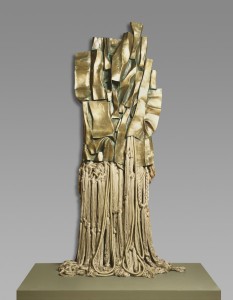
Hunt-Riboud created four in the series of thirteen Malcolm X steles in 1969, four years afterwards the ceremonious rights leader was assassinated. The remainder were made in two campaigns of work in 2003 and 2007-eight. Perhaps the nigh unusual and mysterious thing about them is the consistency of the artist'southward style over a forty year period. She had placed previous bronze reliefs on the floor, and credits her friend and fellow departer artist, Sheila Hicks (they attended graduate school together and both moved to Paris in the 1960s), with suggesting the draped yarn every bit a means to hibernate the supporting structures. The size and format of the Malcolm X steles inevitably telephone call to mind large, ceremonial masks fabricated by numerous cultures in Africa, Due south America and Polynesia, which have raffia skirts to hide the trunk of the wearer, although the artist has said she was trying to avoid the association with such dancing masks.
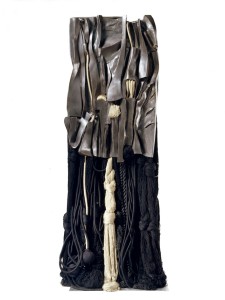
The bronze reliefs recall a largely-overlooked tradition of cast bronze sculpture made in both the U.Southward. and Europe in the ii decades following WWII.These works were abstract, or figurative but highly-abstracted, and suggested a content well beyond the formal. I am thinking of work by artists such as Seymour Lipton, Herbert Ferber, Lynn Chadwick, Germaine Richter, Edouard Paolozzi, Arnaldo Pomodoro, Marino Marini and others, too every bit the one artist whose reputation has survived, Alberto Giacometti. Little by the others is on view in U.Southward. museums today. Much of their fine art featured intricately-worked surfaces, similar to Chase-Riboud's. The pieces she fabricated prior to the Malcolm X steles fit remarkably well inside this tradition.
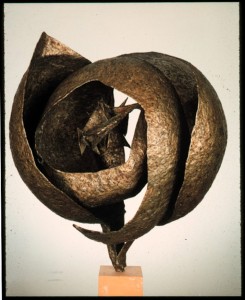
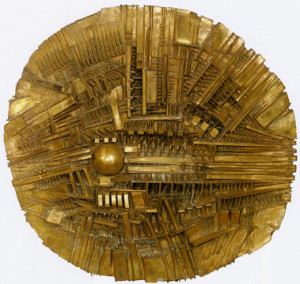
The process of lost-wax casting
The artist has credited her discovery of the lost wax method for statuary casting as enabling the intricate undercutting of her bronzes. She actually models in wax, rather than in clay or plaster, which normally precedes the wax copy that is expended to create the bronze. The bronzes of the steles are folded, crimped, and cutting. A great number of smaller forms have been assembled into more or less ordered wholes. Some have breaks and openings between the channels of the forms, as if they were structures one could enter and get out. The bronzes as well have remarkably varying patination. Malcolm 10 #2 (1969) is almost blackness, and the regular skeins of matte, black wool hanging below expect remarkably like hair. The bronze appears to have been cast from several pieces of leather which were bent into large, organic-looking folds, and has a chugalug-like course that ends with a tassel. The bronze of Malcolm Ten #three (1969) has sharp folds that have been dented and aptitude, suggesting that it was based upon a model formed from metal. It has an elaborately coifed base which is too a glistening aureate. #11 (2008) has an even brighter and shinier gilt patina, with a silk skirt the color of straw. #10 (2007) and #xiii (2008), both dark bronzes, each has a lighter colored, cobweb swag or coil that meanders in and out of the statuary forms before joining a group of dark skeins which drop to the floor. The bronze of All that Rises Must Converge/ Cherry-red (2008) is one of the five sculptures from other serial that are sited inside and around the central gallery. It is deep red, dissimilar any bronze surface I know, with a skirt of key crimson.
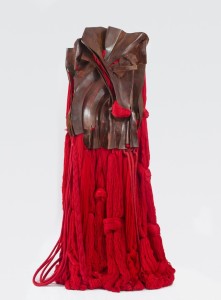
Chase-Riboud's apply of yarn not only affiliates her work with that of Hicks, but as well with a number of sculptors working during the 60s and 70s who created large works out of wrapped, woven, knotted, stitched and knitted textiles and fibers, sometimes combined with other media. They include Magdalena Abakanowicz, Lee Bontecou, David Hammons, Eva Hesse, John Outterbridge, Alan Shields, Faith Wilding and Jackie Winsor, as well as Ruth Asawa and Lenore Tawney, who were marginalized under the heading of craft.
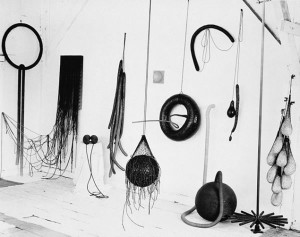

Work evocative of many traditions
Chase-Riboud has traveled widely and purposely forged a syncretic fine art from multiple traditions, including that of Aboriginal Egypt, China and modern Africa. She claims a right to a global heritage by virtue of her wide interests, travels and studies. Her employ of cloth materials and willingness to combine media is certainly an acknowledgment that other cultures hold these in more esteem than does the West, where she was raised and educated.
The drawings and newspaper monuments and Piranesi
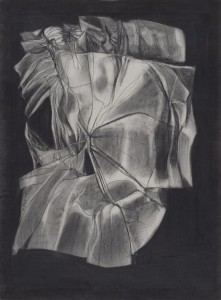
The exhibition besides includes two groups of drawings, which reveal Chase-Riboud to be an extraordinarily gifted draughtsman. The commencement, from the 1960s-70s begins with a sequence of increasingly-bathetic images of 2 figures on a bed, then includes an assortment of others where the creative person explores the imagery of cords and stones, either stones equally found in the landscape or as ruins of a built structure.
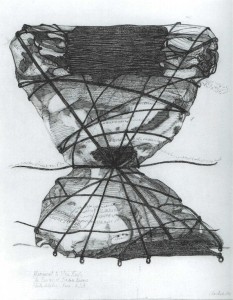
The 2d grouping of drawings line the walls of the gallery housing the Malcolm X steles. Hunt-Riboud made nigh of them during 1996-97, and then added a final drawing in 2011. All are imaginary monuments, more often than not to a surprising array of historical figures, including Sheshonq Two, Pushkin, Zola, Francesco di Giorgio and Rubens' mother. They extend the imagery of stones and cords in the earlier drawings, and since the monuments appear to be outdoors, I assumed that the cords were intended to exist metal. I realize that makes no sense, as these are non proposals for monuments, but Paper Monuments, much similar the Newspaper Architecture created during the Soviet era by architects who were forbidden to build.
The Newspaper Monuments each began with an identical carving of what appears to be a bundle of fabric, the central portion of which is leap with densely-wound string. It sits horizontally, a quarter of the mode up (or down) the page. The artist worked the image variously into each monument as she re-worked the etching with charcoal, charcoal pencil and ink. Sometimes information technology becomes ane arm of a structure, or a lintel beyond an opening. It has been incorporated and then thoroughly into other monuments that it all but disappears. Some monuments make adequately articulate references to their subjects, such as the Monument to Homo Ray's "The Enigma of Isidore Ducasse," Philadelphia, which takes the form of the eponymous sculpture. Others are more open up to interpretation, such equally the Monument to Sheba, which resembles an anatomical drawing of a uterus. Each cartoon bears inscription, sometimes extensive, and not always legible – by intent. And each features a horizontal string, and sometimes its shadow, as if Chase-Riboud finished each cartoon with a not bad flourish.
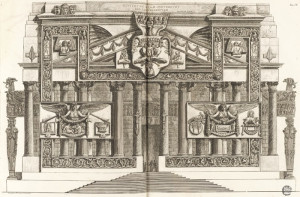
These Paper Monuments are not only beautifully-drawn, but beautifully laid out, so that the series becomes an exploration of the possibilities of imagery, text, and the blank paper surrounding them. These monuments, and indeed, much of Hunt-Riboud's work, reminds me of the imaginary buildings in the belatedly prints by Giovanni Battista Piranesi, the eighteenth century builder who built nearly cipher. I'm non referring to Piranesi's nearly famous prints, the imaginary prisons, nor to his much-valued views of Rome. No – it is his fantastical buildings and mantelpieces, where the long-time student of Greek and Roman classicism also inserts motifs from Etruscan and Egyptian buildings – creating mongrel forms that were not ever appreciated. The imaginary edifice, seen above, bears an inscription from the Roman historian, Sallust: Novitatem meam comtemnunt, ego illorum ignaviam (They despise my novelty, I their timidity).
Barbara Chase-Riboud; The Malcolm Steles, curated by Carlos Basualdo, is on view at the PMA through January. 20,2014 and at the University of California, Berkeley Fine art Museum from Feb. 12 to Apr 27, 2014.
Source: https://www.theartblog.org/2013/10/barbara-chase-ribouds-bronze-steles-and-paper-monuments-at-the-philadelphia-museum-of-art/
0 Response to "Barbara Chaseribouds Bronze Steles and Paper Monuments at the Philadelphia Museum of Art"
Post a Comment